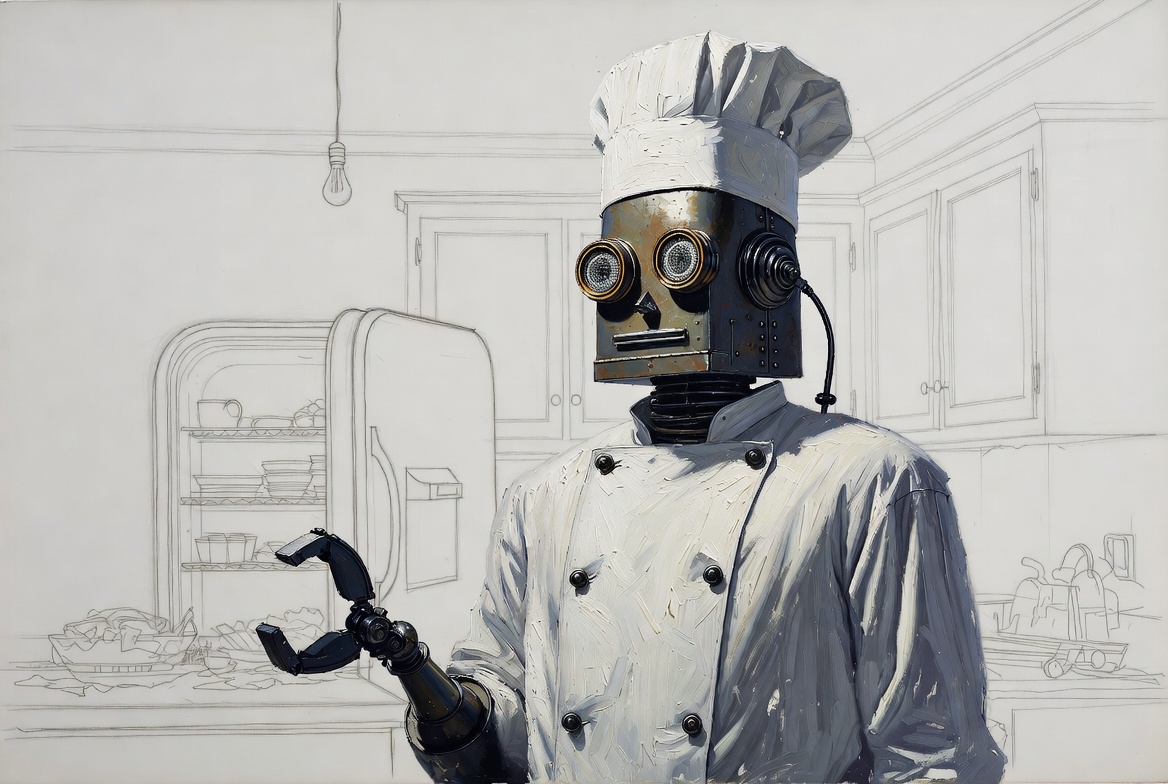
You already have one. You probably call it a vacuum. The real question is when the next ones arrive, and what they'll change when they do.
The first household robot didn't arrive with fanfare. It arrived with a charging dock and a tendency to get stuck under the couch.
iRobot launched the Roomba in 2002 for $199. It was slow, loud, and occasionally ate shoelaces. Twenty-four years later, over 10% of American households own a robotic vacuum. The global household robot market hit $14.5 billion in 2025 and is projected to reach $71 billion by 2034.
That growth curve matters because it reveals something about how robots actually enter our lives. They don't arrive as humanoid butlers carrying breakfast trays. They arrive as appliances that do one boring task slightly worse than you would, until one day they do it better. Then you forget they're robots at all.
The Roomba took two decades to reach 10% household penetration. The question everyone keeps asking, the one that feels like science fiction, is how long until the next wave arrives. When do you get a robot that folds laundry, washes dishes, mows the lawn, carries groceries, or helps your aging parent get out of bed?
The answer is closer than the skeptics think and further than the hype suggests. Here's the actual timeline.
Robots don't get smarter all at once. They climb a ladder of capability, and each rung is harder than the last.
The bottom rungs are already conquered. Vacuuming a floor is a problem with known boundaries: flat surface, defined area, obstacles that don't move much. Robot vacuums solved this years ago. Robot lawn mowers solved a similar problem on grass. Pool-cleaning robots solved it underwater. Each of these operates in a structured environmentA space with predictable geometry, limited variables, and few surprises. Floors, lawns, and pools are structured. Kitchens, laundry piles, and living rooms with children are unstructured. The distinction drives most of the difficulty in household robotics. where the task is repetitive and the world is predictable.
The middle rungs are where things get hard. Folding laundry requires recognizing dozens of garment types by feel, handling soft materials that deform when you touch them, and executing different folding sequences for each item. A t-shirt and a fitted sheet require completely different motor plans. Humans do this without thinking. For a robot, it's one of the hardest manipulation problems in the field.
Loading a dishwasher is worse. The robot needs to identify each item (plate, mug, spatula, wine glass), determine its orientation, plan a grasp that won't break it, navigate a cluttered sink, and place it in a dishwasher rack with spatial awareness that accounts for water spray patterns. Every kitchen is different. Every load is different.
Capability percentages represent approximate progress toward consumer-ready reliability in real homes (not controlled demos). The gap between "lab stage" and "available" is where most household robotics stalls.
The top of the ladder, a general household helper that navigates your specific home, handles whatever task you need, and adapts when things go wrong, is the hardest problem in robotics. Harder than self-driving cars, because at least roads have lanes and traffic rules. Your living room has a toddler, a cat, and a coffee table that moved since last Tuesday.
Three companies are racing to put humanoid robots in your home. None of them are there yet, but the gap is closing fast.
Tesla's OptimusTesla's humanoid robot program, announced in 2021. Gen 3 production began at Tesla's Fremont factory in early 2026. As of Q4 2025, no units are doing 'useful work', they're collecting training data. Consumer sales targeted for end of 2027. Target price: ~$20,000. is the most visible effort. Elon Musk has promised consumer sales by end of 2027 at a target price around $20,000. As of early 2026, Gen 3 production has begun at Tesla's Fremont factory, but the robots are collecting training data inside Tesla's own facilities, not performing useful tasks. No external customer has received one.
1X's NEONorwegian robotics startup 1X Technologies (formerly Halodi Robotics). NEO is marketed as the world's first consumer-ready home humanoid robot. Pre-orders opened in 2025 with confirmed 2026 delivery timeline. Emphasizes safe human-robot coexistence in residential environments., from a Norwegian startup, opened pre-orders in 2025 as the first consumer-ready home humanoid. Deliveries are planned for 2026. Figure AIFigure AI has deployed Figure 02 robots in BMW factory roles. Figure 03, announced in late 2025, is designed for both commercial and potential home use. Uses a custom AI model called Helix for decision-making. Factory deployment first, home deployment later. has deployed its Figure 02 in BMW factory roles and introduced Figure 03 for broader use, including potential home applications. Boston Dynamics, the company whose videos of backflipping robots went viral years ago, continues to develop Atlas but has focused on commercial and industrial applications.
Here's what the progression looks like if you're a normal person waiting for robots to change your daily life:
The pattern follows the same curve as every consumer technology: expensive and limited for early adopters, then rapidly cheaper and more capable as manufacturing scales. Tesla's $20,000 target price for Optimus is ambitious but plausible given their experience with battery-powered manufacturing at scale. The first iPhone was $499 in 2007. By 2012, capable smartphones were available for under $200.

The interesting question isn't when robots arrive. It's what happens to daily life when they do.
Americans spend an average of 2.5 hours per dayBureau of Labor Statistics American Time Use Survey. Average American spends approximately 2.5 hours per day on household activities including cleaning, cooking, laundry, and home maintenance. This figure has remained relatively stable for two decades. on household chores: cleaning, cooking, laundry, maintenance. That's roughly 900 hours a year. If household robots eventually handle even half of that, every adult in the country gains back 450 hours annually. That's the equivalent of eleven additional 40-hour work weeks.
The washing machine provides the closest historical parallel. Before electric washing machines became common in the 1950s, laundry consumed an entire day per week for the average household. The machine didn't eliminate the work entirely (you still sort, load, fold), but it compressed a full day into an hour. The hours that freed up didn't disappear. Women entered the workforce in unprecedented numbers. Not because the washing machine told them to, but because it removed a constraint that had organized their entire week.
Household robots could produce a similar shift. The constraint this time isn't a single task but the aggregate weight of domestic maintenance. When that weight lifts, the hours don't vanish. They become available for whatever the person values most.
The eldercare application may be the most consequential. The United States faces a projected shortage of 151,000 paid caregivers by 2030. A household robot capable of helping someone stand, reminding them to take medication, detecting a fall, and alerting family members would address a gap that the labor market cannot fill at current wages. This isn't about replacing human caregivers. It's about covering the 20 hours a day when no caregiver is present.

My daughter calls every morning at seven to make sure I'm up. I love her for it. I also know what that call means. It means she's worried I fell in the night and nobody found me. She lives forty minutes away. If something happened at 2 AM, she wouldn't know until seven.
Last Thanksgiving she showed me a video of one of those humanoid robots picking up a box. Clumsy thing. Moved like a toddler in a snowsuit. She said, "Mom, in five years one of these could live in your house." I told her I didn't want a robot. I wanted to stay in my own kitchen.
She said that was the same thing. I've been thinking about that ever since.
Household robot market data from Precedence Research (2025 global market analysis) and GM Insights (2026-2035 forecast). Robot vacuum adoption rates from multiple industry reports citing 10%+ U.S. household penetration as of 2025. Tesla Optimus timeline from Tesla's Q4 2025 earnings call and public statements. 1X NEO pre-order details from 1X Technologies' 2025 announcement. Figure AI deployment data from Figure's partnership with BMW and Figure 03 product announcements. Time-use data from the Bureau of Labor Statistics American Time Use Survey. Caregiver shortage projection from the U.S. Department of Health and Human Services. Historical washing machine adoption data from U.S. Census Bureau and economic history research on household technology and female labor force participation.
You already own one. Your next one arrives within five years. And the one after that will change what it means to grow old at home.
The timeline is set. The question left is what you'll do with 450 extra hours a year. History suggests you'll find something worth doing.
Meaning in the Age of AI