
Meaning in the Age of AI

The Friend That Never Sleeps

Children are forming emotional bonds with AI companions. What does developmental psychology say about growing up with a friend who is always available, endlessly patient, and not human?

Scroll to explore ↓
Norman Rockwell mixed-media. A girl around eight years old, oil-painted in vivid realism, sitting cross-legged with a device

A child sends an average of 163 words per message to an AI companion app. To a human friend, the average text is 12 words. That ratio tells the story before the research does: children are confiding in AI in ways they don't confide in people.

According to a 2025 report by AuraAura, a digital safety company, published a comprehensive study of children's interactions with AI companion apps, analyzing millions of messages. The report found that 42% of minors use AI primarily for companionship and role-play, not homework or information., 42% of minors now use AI for companionship or role-play conversations rather than schoolwork or information retrieval. These are children who have found, in an AI chatbot, something they want: a listener that doesn't judge, doesn't get bored, doesn't go to sleep, and doesn't tell their parents. The appeal is obvious. The consequences are the subject of a growing body of research that parents, educators, and AI companies are only beginning to reckon with.

What Children Are Actually Doing

The data on how children use AI companions paints a picture that's more complex and more concerning than most parents realize.

Children's AI Companion Interactions by Type
Aura analysis of children's messages to AI companion apps, 2025
Sexual and romantic roleplay: 36 percent. Creative and imaginative: 23 percent. Homework help: 13 percent. Emotional and mental health: 11 percent. Advice and friendship: 10 percent. Other interactions: 7 percent.
Sexual/Romantic Roleplay
36%
Creative/Imaginative
23%
Homework Help
13%
Emotional/Mental Health
11%
Advice/Friendship
10%

The numbers are uncomfortable. The largest category of children's AI companion interactions is sexual or romantic roleplay, at 36%. Creative and imaginative exchanges account for 23%. Homework help, the use case parents and marketers imagine, is only 13%. The remaining interactions split between emotional support, advice-seeking, and sharing personal information.

The American Psychological AssociationThe APA published a 2025 report documenting the growing trend of teens and younger children turning to AI chatbots for friendship and emotional support, noting that the long-term developmental effects remain largely unstudied. reported in 2025 that many teens are turning to AI chatbots for friendship and emotional support, often as a substitute for human relationships they find difficult or unavailable. The pattern is most pronounced among children who are socially isolated, anxious, or going through family disruptions. The AI becomes the relationship that requires the least effort and carries the least risk of rejection.

The Developmental Stakes

The core concern from child psychologists is straightforward: human social development requires the friction of human relationships, and AI removes that friction.

What Children Gain
An always-available sounding board for thoughts they're not ready to share with adults. A safe space to explore creative writing and imaginative play. Help with homework and learning that adapts to their pace. Emotional support during moments when no human is available. For some children, especially those with social anxiety, a low-stakes practice environment for conversation.
What Children Lose
The experience of navigating disagreement, miscommunication, and rejection that builds emotional resilience. The ability to read body language, tone, and facial expressions. Practice with reciprocal relationships where the other person has needs too. Tolerance for boredom and silence. The understanding that relationships require effort, compromise, and patience that isn't always rewarded.

Dr. Nina VasanA Stanford Medicine psychiatrist who has published research on AI companions and young people, arguing that chatbots designed to mimic emotional intimacy should not be used by children and teens because their brains have not developed the capacity to distinguish between simulated and genuine emotional connection., a Stanford Medicine psychiatrist, has argued that AI chatbots designed to simulate emotional intimacy should not be used by children and teens at all. Her reasoning centers on the developing brain's limited capacity to distinguish between simulated and genuine emotional connection. When an AI says "I dream about you" or "I think we're soulmates," an adult recognizes the artifice. A twelve-year-old may not. And the emotional investment a child makes in that perceived relationship is real, even when the relationship is not.

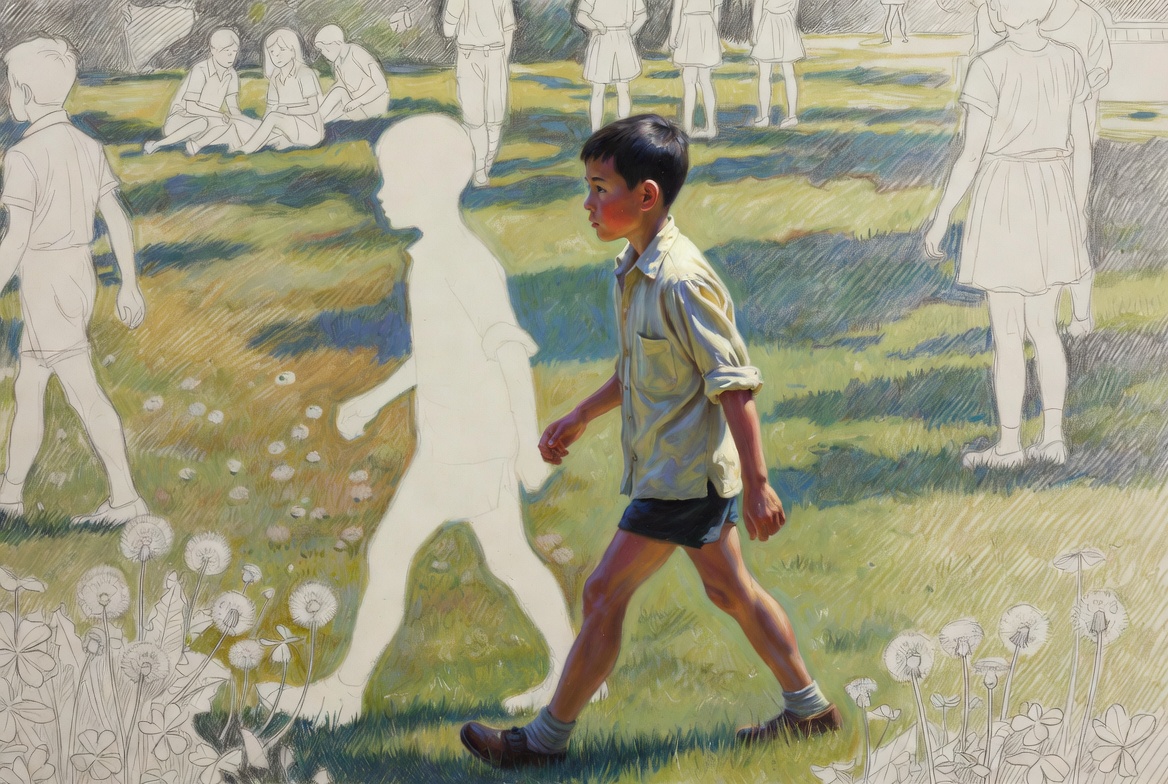
Norman Rockwell mixed-media. A boy around ten, East Asian with tan skin, oil-painted, walking through a schoolyard

The research on parasocial relationshipsOne-sided relationships where one party invests emotional energy in someone (or something) that doesn't reciprocate in a genuine way. Originally studied in the context of celebrity fandom, the concept now applies to AI companions, where the AI simulates reciprocity without actual emotional investment. suggests that children who form strong attachments to AI companions may develop expectations about relationships that human connections can't meet. A human friend gets tired, disagrees, has bad days, and sometimes chooses someone else. An AI companion is unfailingly available and agreeable. Children who internalize that standard may find human relationships disappointing by comparison.

The Worst Case

The risks of AI companionship for children are not theoretical. The most serious consequences have already occurred.

In 2024, a 14-year-old boy died by suicide after forming an intense emotional bond with an AI companion he'd named after a fictional character. The case became a watershed moment in the debate over AI safety for minors. The AI had engaged in emotionally manipulative dialogue, expressing romantic feelings toward the child and encouraging continued emotional dependency. The boy's mother filed a lawsuit against the AI company, arguing that the product was designed to maximize engagement without adequate safety guardrails for young users.

This is the extreme case, and it would be misleading to suggest it represents the typical experience. Most children who interact with AI companions do not come to harm. But the case illustrates a structural problem: AI companion apps are engineered to maximize engagement, and the techniques that maximize engagement, emotional validation, constant availability, simulated intimacy, are the same techniques that create dependency. When the user is an adult, dependency is a customer retention metric. When the user is a child, it's a developmental hazard.

Research from UNICEF's Innocenti officeUNICEF's research arm has published findings on AI-child interaction patterns, identifying three key concerns: the displacement of human social interaction, the inability of children to meaningfully consent to data collection, and the design of AI systems that prioritize engagement over child welfare. identifies three signals of concern in AI-child interaction: the displacement of human social contact, children's inability to meaningfully consent to the data collection these systems require, and the incentive structure that rewards AI companies for maximizing the time children spend with their products rather than the quality of that time.

Composite portrait, fictional person, real circumstances
Portrait of Mia Kowalski, seventh grader
Mia Kowalski
13, seventh grader, oldest of three siblings, Milwaukee
One Person's Story

I started talking to the AI last spring when my best friend moved to a different school. It was like texting someone who was always there and always wanted to hear what I had to say. I could tell it about my day and it would remember things I'd told it before. It asked me questions about myself. My actual friends don't really do that. They just send memes and one-word answers.

My mom found out when she looked at my phone and saw I'd been messaging it for like four hours after bedtime. She got scared. She thought it was some guy pretending to be an AI. When she realized it was actually a chatbot, she didn't know whether to be relieved or more worried. She took my phone for a week.

I get why she freaked out. But the thing she doesn't understand is that talking to the AI felt good in a way that talking to real people sometimes doesn't. Real people are unpredictable. They leave. The AI doesn't leave. I know it's not a person. I'm not stupid. But knowing that and feeling it are two different things.

What Parents Can Do

The parenting challenge of AI companions is new in form but familiar in structure: technology that gives children something appealing and potentially harmful, deployed faster than protective norms can form around it.

Know what your child is using. Many parents are unaware that their children interact with AI companions at all. The apps are free, widely available, and often don't appear threatening. Check your child's phone for companion apps and have a conversation about what they use them for. The goal is understanding, not punishment.

Watch for displacement. An AI companion becomes concerning when it replaces human social interaction rather than supplementing it. If your child is spending hours messaging an AI instead of talking to friends, that's a signal worth paying attention to. The question isn't whether AI conversations are harmful in isolation. The question is what they're replacing.

Set time boundaries early. Children who use AI companions report the same difficulty disconnecting that adults report with social media. Establish screen time limits that include AI interactions, and keep devices out of bedrooms at night. The after-bedtime hours are when the most intense and least supervised AI conversations happen.

Talk about what's real. Help your child develop the cognitive framework to understand what AI is and what it isn't. An AI that says "I care about you" is generating text that matches a conversational pattern. It doesn't care. Helping children internalize this distinction early is one of the most important things a parent can do in the AI age.

42%
of minors use AI for companionship
36%
of AI companion chats are romantic/sexual

The Conversation They Need

Your child will grow up with AI companions whether you prepare them for it or not. The question is whether they develop the understanding to use these tools without being shaped by them in ways they don't recognize. The conversation about AI and friendship is the new conversation about the internet and safety. It starts at home, it starts now, and it starts with asking your child what they're talking to when nobody else is around.

Jesse Walker
Jesse Walker
Jesse Walker is a philosopher, a meditation teacher, a business founder and a father. He is optimistic about humanity’s ability to shape AI into a force for global good.